
Braces colors: how to pick your bands
The little elastic rings around each bracket are yours to choose, and you get to change them at every visit. Here is how to pick a color you will still like in six weeks.

What the colors actually are
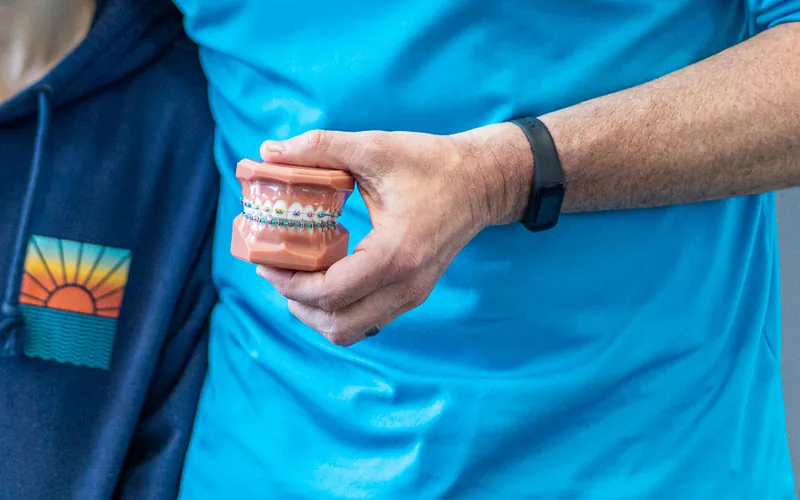
Each bracket is held to the archwire by a small elastic ring called a ligature. Those rings are what you see when someone has colored braces, and they are replaced at every adjustment visit as a matter of routine.
That means the color is never a permanent decision. If you pick something and decide you are done with it, the next visit is a clean slate.

Picking a color you will still like
A few things that reliably work: school or team colors, something seasonal, or two shades alternated around the arch. Deeper colors like navy, emerald and deep purple create contrast against enamel, which tends to flatter the smile.
Think about the six weeks ahead too. Class photos, a recital, a wedding, a game. It is worth choosing with the calendar in mind.

The ones that stain
Clear and white ligatures look sharp on day one and pick up color fast from coffee, tea, curry, tomato sauce and berries. If you want something light that holds up, a pale silver or pearl is the safer pick.
Very dark brown and deep green can read as food caught in the braces from across a room, and yellow or gold sits close to natural tooth shade. None of these will hurt anything, they just photograph differently than people expect.
See clear bracesThe color chart, group by group
Offices stock a similar range of ligature shades. Here is how the common groups tend to look once they are on, so you can shortlist a couple before your visit.
Blues and purples
Navy, royal, sky blue, teal, lavender and deep purple. The darker end of this group gives the most contrast against enamel, which is what makes a smile read brighter in photos.
Greens
Emerald, forest, mint and turquoise. Emerald and turquoise photograph well. Very dark green is the one to think twice about, since from across a room it can read as food caught in the brackets.
Reds, pinks and oranges
Scarlet, maroon, hot pink, blush, coral and orange. The bright warm shades stand out in photos, and maroon is a steady pick that still works alongside most school colors.
Neutrals and metallics
Silver, pearl, smoke grey, clear and white. Silver and pearl are the quiet choices that hold up over six weeks. Clear and white look sharp on day one and pick up stain the fastest.
Yellows and golds
Lemon, gold and amber. These sit close to natural tooth shade, so they can make enamel read a little duller than it is. Worth holding against your own teeth before you commit.
Two-color combinations
Alternating two shades around the arch is a popular choice. School and team colors, holiday pairs, or one bright shade alternated with silver all work well.
Still deciding? You do not have to settle it in advance. The bands are replaced at every adjustment, so you get a fresh choice each visit. See braces for kids and teens.
The color wheel you will see in the chair
The shade names above come from the physical color ring that orthodontic offices keep on hand. It is a loop of ligature samples you can hold up against your own teeth, and it settles the question faster than any photo, because it shows the shade next to your enamel and under the same light. If you would like to see it before you choose, just ask.
A useful way to work through it: shortlist two or three groups from the chart above, then compare only those on the ring. Starting from the full set is where most people get stuck. And if you change your mind a few weeks in, the next adjustment is a clean slate.
One thing worth knowing before you look. The colors on the ring are the bands, not the brackets. Clear braces change the bracket itself to a tooth-colored ceramic, which is a separate decision from band color and one your doctor will walk through at your evaluation.
Common questions about braces colors
Ask us anythingWhat are braces colors actually made of?
How often can I change my braces colors?
Which braces colors make teeth look whiter?
Do braces colors stain?
What colors should I avoid?
Can adults get colored braces?
Do clear braces have colors too?
Can I mix two colors?
Is there a braces color chart I can look at?
What color braces should I get?
Are the brackets colored, or just the bands?
Is there a braces color wheel I can use to choose?
Thinking about braces?
Come meet the doctors, get a plain-language look at your smile, and leave with clear options. No dentist referral is needed for most patients.
Request an Evaluation